
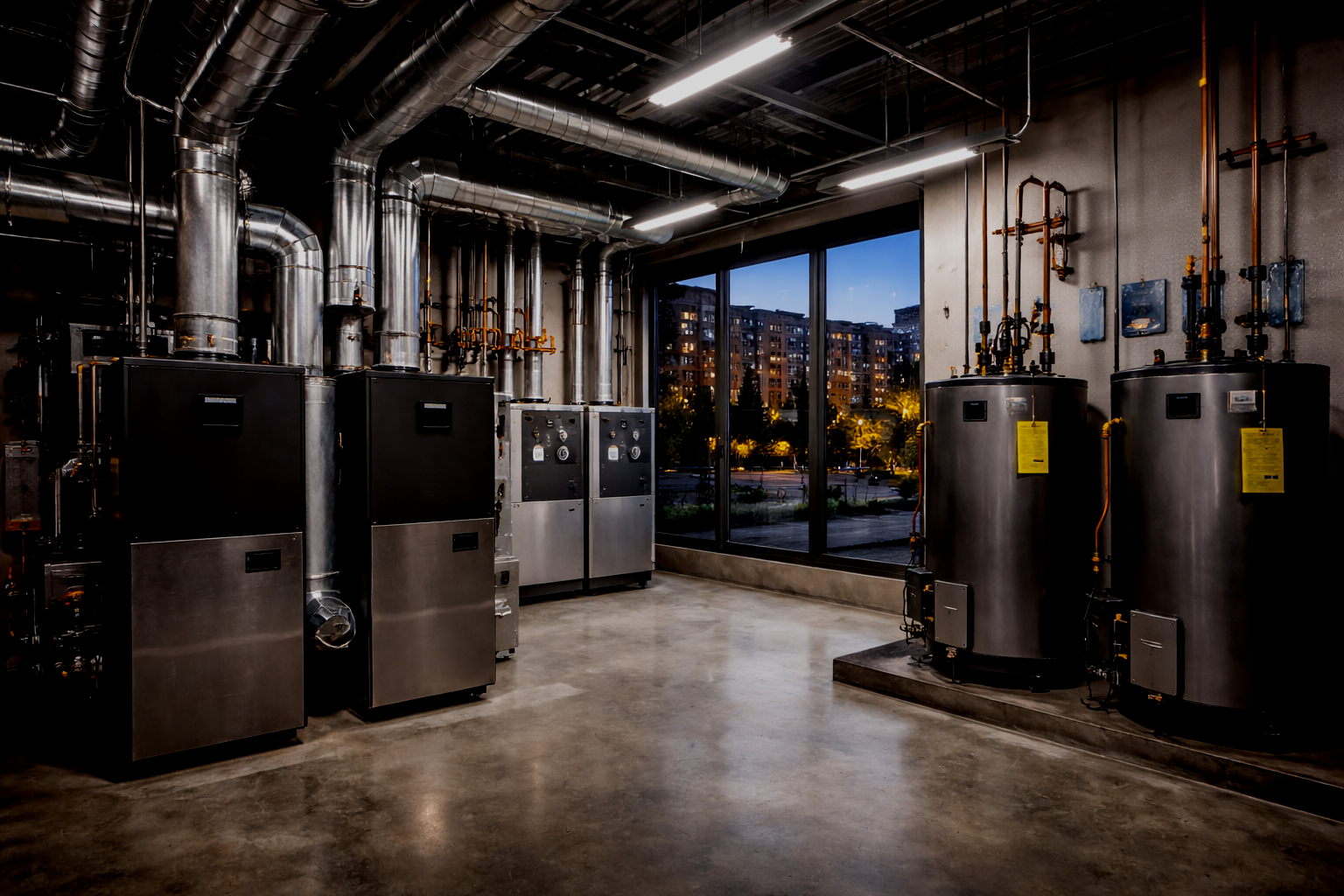

A Permanent Mechanical Identification Standard
The Harmelo Mechanical Identification Number (HMIN™) establishes a persistent identity layer for residential mechanical systems, preserving verified lifecycle history across portfolios, ownership transitions, and decades.
HMIN can be introduced across housing portfolios at no cost to establish a baseline mechanical governance layer.
What Is Included at No Cost?
HMIN is introduced as baseline registry infrastructure to establish continuity across housing portfolios without creating procurement barriers or operational disruption.
The objective is to create a durable system of record that allows mechanical systems to be consistently identified and understood over time.
No-cost deployment establishes foundational lifecycle continuity while enabling organizations to evaluate participation without financial pressure.
No-cost deployment includes:
• HMIN issuance for mechanical systems
• Registry enrollment across participating properties
• Persistent mechanical identity layer
• Append-only lifecycle record framework
• Documentation continuity baseline for future oversight
This foundational layer exists to provide a stable reference across ownership transitions, contractor changes, and decades of operation.
Optional layers available where appropriate:
• HMIN Reports and standardized reporting views
• Portfolio analytics and risk insights
• Warranty and program integrations
• Advisory and implementation support
• Data services and integrations
Participation at the registry level does not require adoption of additional services.

Registry Principles
HMIN is designed as long-horizon infrastructure. Its operation is guided by a set of principles intended to support stability across decades.

• Neutral stewardship
The registry functions as a neutral reference layer and does not favour any service provider, contractor, or technology.
• Vendor independence
Participation does not require changes to existing systems or operational workflows.
• Long-term record preservation
Lifecycle records are maintained to support continuity across ownership transitions, service cycles, and institutional changes.
• Privacy by design
Data access is governed through appropriate permissions and organizational control.
• Public-interest alignment
The registry supports safer operations, clearer reporting, and more informed capital planning across housing and infrastructure ecosystems.
The Harmelo Mechanical Identification Number (HMIN™) is a persistent identifier assigned to a mechanical system, creating a neutral reference layer for installation data, service history, and lifecycle events.
It does not manage equipment.
It preserves continuity.
What Is a HMIN™ ?
The Continuity Problem
Mechanical systems routinely outlast installers, service providers, and ownership cycles. As continuity breaks, documentation fragments, and decisions default to assumption.
HMIN™ anchors system history across time.
Registry Structure
Each HMIN™ record includes:
• Property location reference
• Equipment make, model, serial
• Installation metadata
• Documented service events
• Replacement history, where applicable
Records are append-only.
Historical entries remain preserved.
Each system maintains a continuous record tied to its unique identification number.

Municipalities & Housing Organizations
HMIN establishes a standardized mechanical record across housing portfolios, enabling consistent oversight without altering operational responsibility.
By introducing persistent system identity, housing operators can:
• strengthen lifecycle planning across aging stock
• improve replacement forecasting accuracy
• reduce exposure to emergency interventions
• support coordination with energy and infrastructure programs
Mechanical systems become governed assets with traceable history rather than fragmented records dependent on institutional memory.

Builders & Large Housing Portfolios
Assigning HMIN at installation establishes continuity that persists beyond construction, ownership transitions, and warranty periods.
HMIN:
• creates a durable mechanical record at handoff
• reduces documentation loss over time
• preserves installation context for future decision-making
• supports long-term traceability across the asset lifecycle
Projects are delivered with enduring system records, not just completed installations.

Licensed Mechanical Contractors
HMIN provides a neutral record of installation and service events, ensuring mechanical history remains intact as properties and service relationships evolve.
Participation supports:
• accurate documentation of work performed
• continuity of system knowledge across service cycles
• reduced friction caused by missing records
• preservation of verified service history
Operational workflows remain unchanged. HMIN functions solely as a continuity layer.

Continuity Supports Long-Term Infrastructure Resilience
Preserved system history supports more deliberate maintenance, extends useful equipment life, and enables more informed upgrade decisions.
Over time, continuity reduces unnecessary replacements, improves coordination with energy programs, and supports more disciplined capital planning across infrastructure portfolios.
Lifecycle clarity strengthens operational resilience as buildings and energy systems evolve.
The registry architecture is designed to extend across mechanical and energy systems as infrastructure evolves, supporting continuity across multiple asset classes over time.