For organizations and professionals responsible for buildings and portfolios. What needs attention across the buildings you hold, the records that justify it, and continuity that survives staff, contractor and ownership changes.
Everyone contributes. Everyone benefits. The history stays with the property.
Property managers and multifamily operators. Contractors and their technicians. Builders, inspectors, institutions, government, and the people accountable for a portfolio. Not homeowners — a homeowner keeping the record of their own house is served by Asset History Report.
It is spread across invoices in an inbox, a contractor’s own system, a spreadsheet somebody maintained until they left, a folder from a handover, and the memory of a technician who has since retired. Every time staff, contractors or ownership change, the picture is rebuilt from scratch — and rebuilt worse.
Harmelo brings condition, records, priorities and work continuity into one governed view, so the picture survives the people who built it.
The buildings with enough evidence carry a condition figure. The ones without say so, rather than being guessed at or quietly averaged in. Alongside them, the capital coming at you and the systems that are past their life. No survey commissioned, no consultant booked.
See the operator view →A weighted figure across the properties that carry one, with the rest counted and named rather than averaged in.
What is coming in dollars, before it becomes an emergency.
Every furnace, boiler, chiller and array on the record.
Raised by the technician who was standing in front of it.
Overdue replacements, flagged equipment and units past their service life, ranked and costed, so the morning starts with a list rather than a search.
See how it ranks →
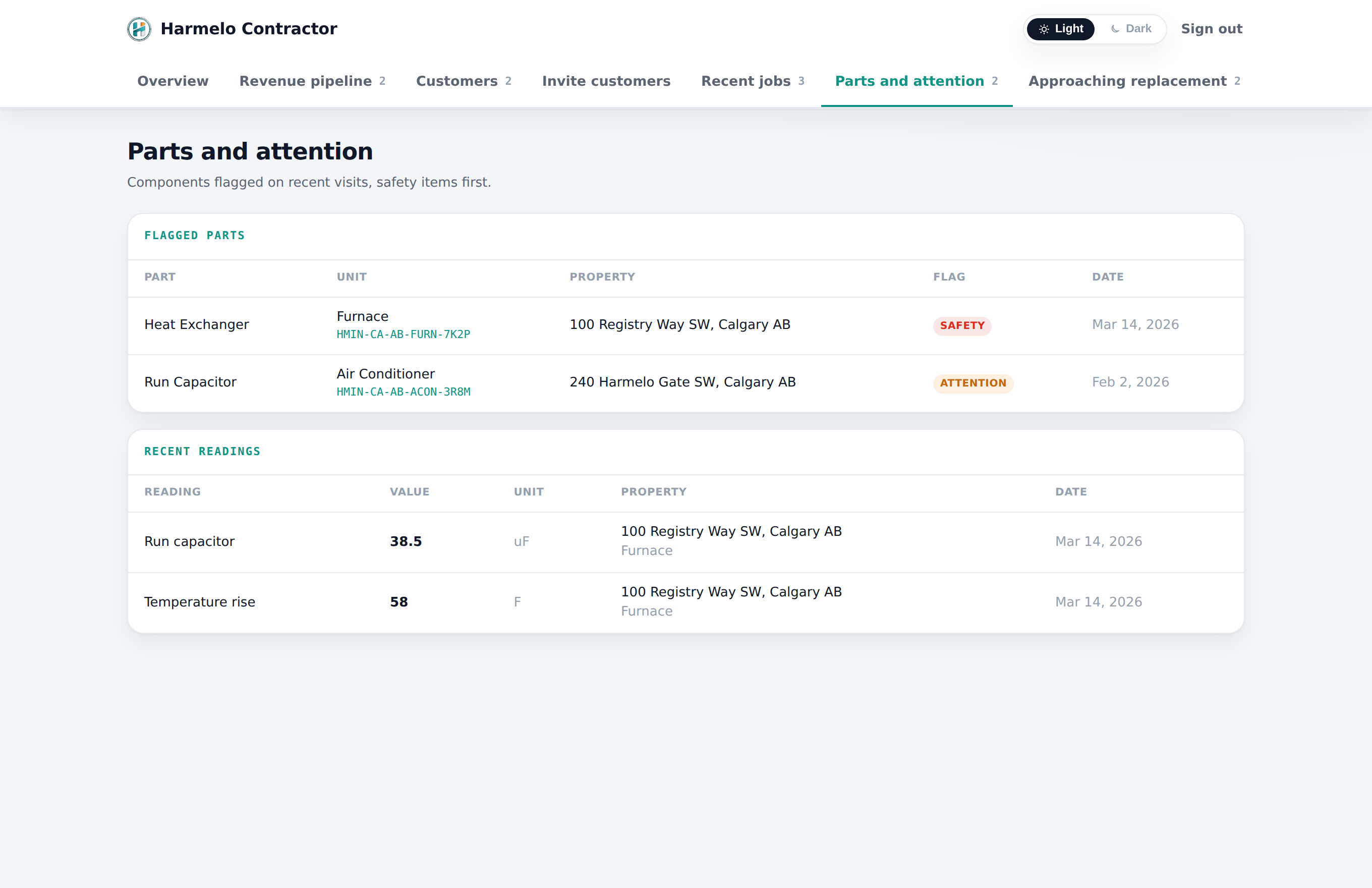
Sorted by what it costs you to ignore it.
An estimate against every item, not a red dot.
Each flag opens the equipment it came from.
The list empties. That is the point of it.
Equipment age and documented service history can help produce an estimated replacement window for capital planning and informed discussions with boards, lenders or funders. Estimates should be reviewed alongside current inspections, professional advice and the organization’s own planning requirements.
See the capital view →
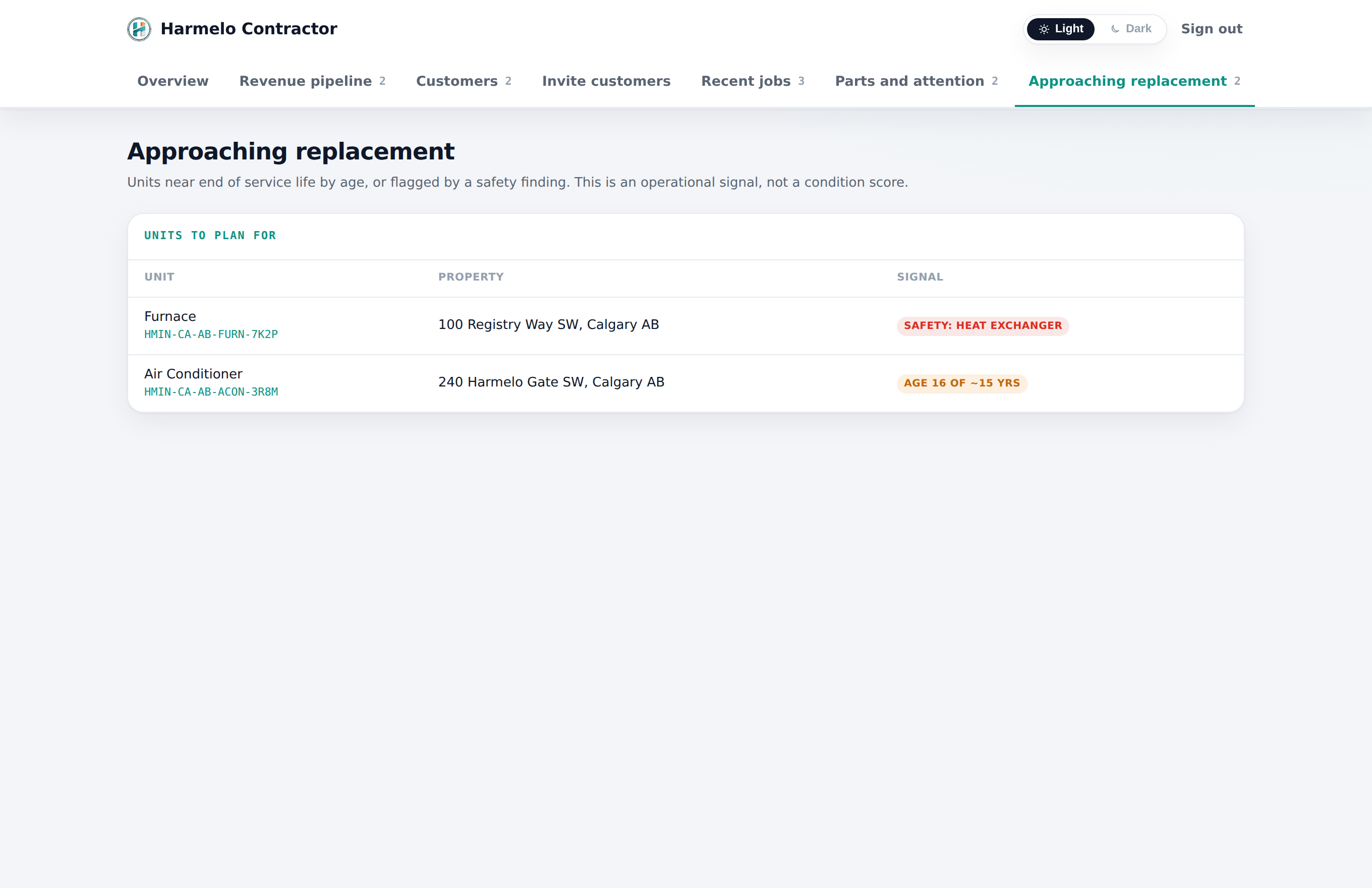
Built on service records, not on a useful life table.
So the plan adds up rather than rounds up.
Replace something and the forecast changes.
Roll it up across every building you hold.
Model, serial, install date, warranty position and every previous visit, on the phone, before the panel comes off. The record is written at the job and signed by the person who did it.
See the contractor side →
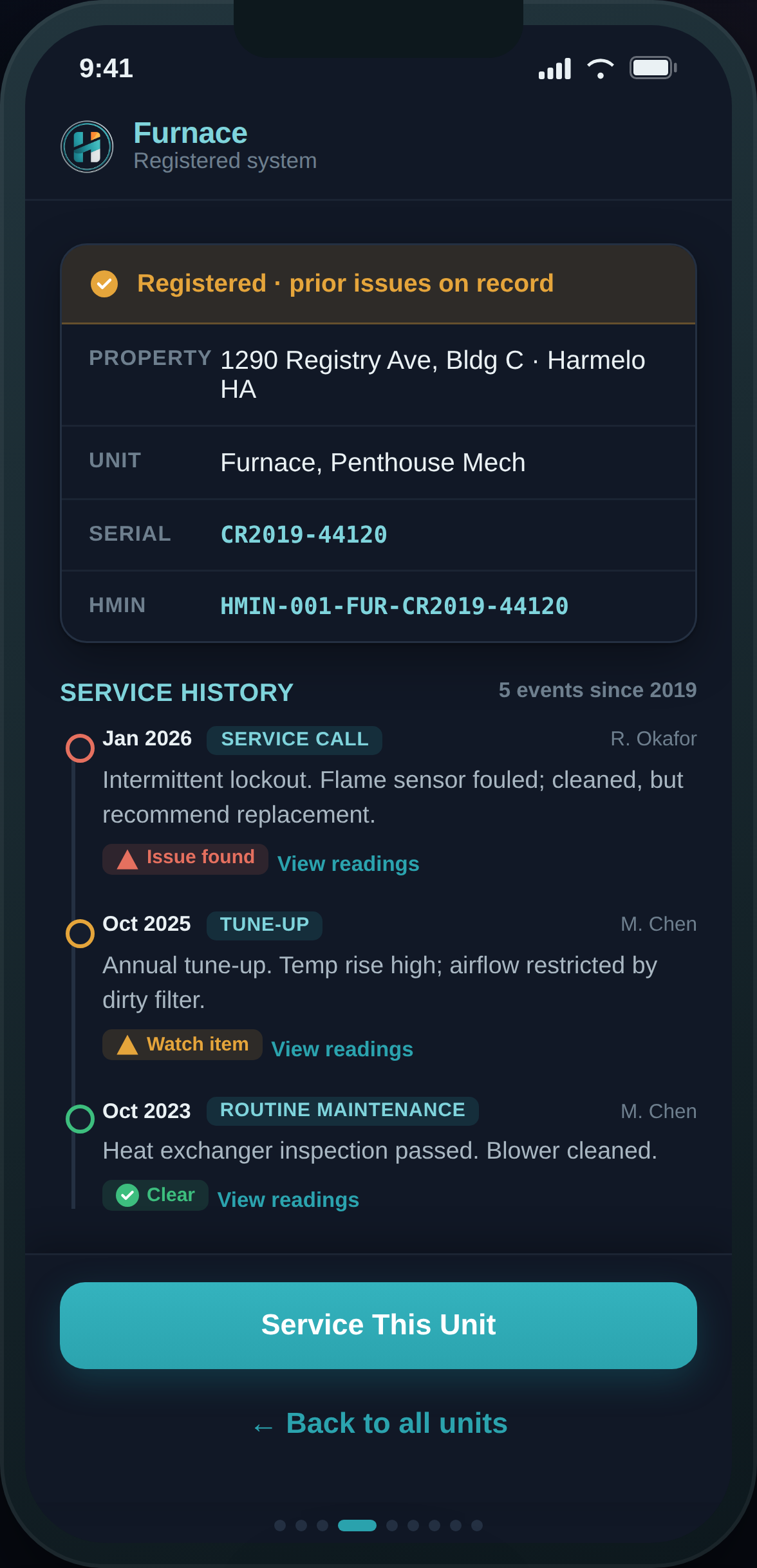
History travels with the equipment, not the technician.
Attributed to the person who did the work.
Contractors never pay to write a record.
A sale, a new operator, a change of software.
Condition, capital and what needs attention across buildings.
Shown in a walkthrough — access is arranged.Equipment, age against service life, and the documents behind each line.
Shown in a walkthrough.What a technician files on site, attached to the right asset under their identity.
Shown in a walkthrough.Customer workspaces, calendar and capital planning inside the operator console.
Shown on request — access is governed.Documents and evidence reviewed under recorded permission, with the basis of a decision retrievable afterwards.
Implemented workflow.Contractor and inspector work carries identity, date and responsibility.
How contractors take part →Views follow role and permission. Nobody sees every workspace, and what an account can open is set by the organization rather than by the page.
One score you can follow, every system's condition, and the capital you will need, before you need it. Generated from the records you already hold.
A boiler is a boiler whether it sits under a rental block, a campus, an arena or a fifty year old housing complex. What changes is the consequence of it failing, who has to answer for it, and how thin the records were when you inherited them.
Central plant, in-suite equipment, common area systems, and a building envelope with a capital plan attached to it. One record per building, one identifier per system.
Many buildings, decades of vintages, and a deferred maintenance figure that has to survive a board, an auditor or a buyer. On guest-facing assets a failure is not a work order, it is a room out of service. The record is per building, the reporting is per portfolio.
Ice plant, large-tonnage refrigeration, air handling for a full house, and a public safety obligation on every one of them. Downtime is not an inconvenience, it is a cancelled event.
The hardest case and the one that matters most: original plant, thin records, and a funder asking what the money bought. This is where a documented condition figure changes what gets approved.
Harmelo keeps service history connected to the building, so owners, contractors, tradespeople and portfolio teams can understand what happened, what changed and what needs attention next.
Harmelo preserves documented work. It does not rank contractors or sell preferred placement.
Service notes and history remain attached to the equipment, creating continuity across visits, contractors and ownership changes.
Harmelo does not certify work quality or promise leads. Participation does not give Harmelo ownership of a stakeholder’s underlying information.
Tell us what you are responsible for and we will show you the record on your own buildings. No account to create, and nothing installed.
Discuss your buildings →A short note is enough. Somebody reads it, not a queue.